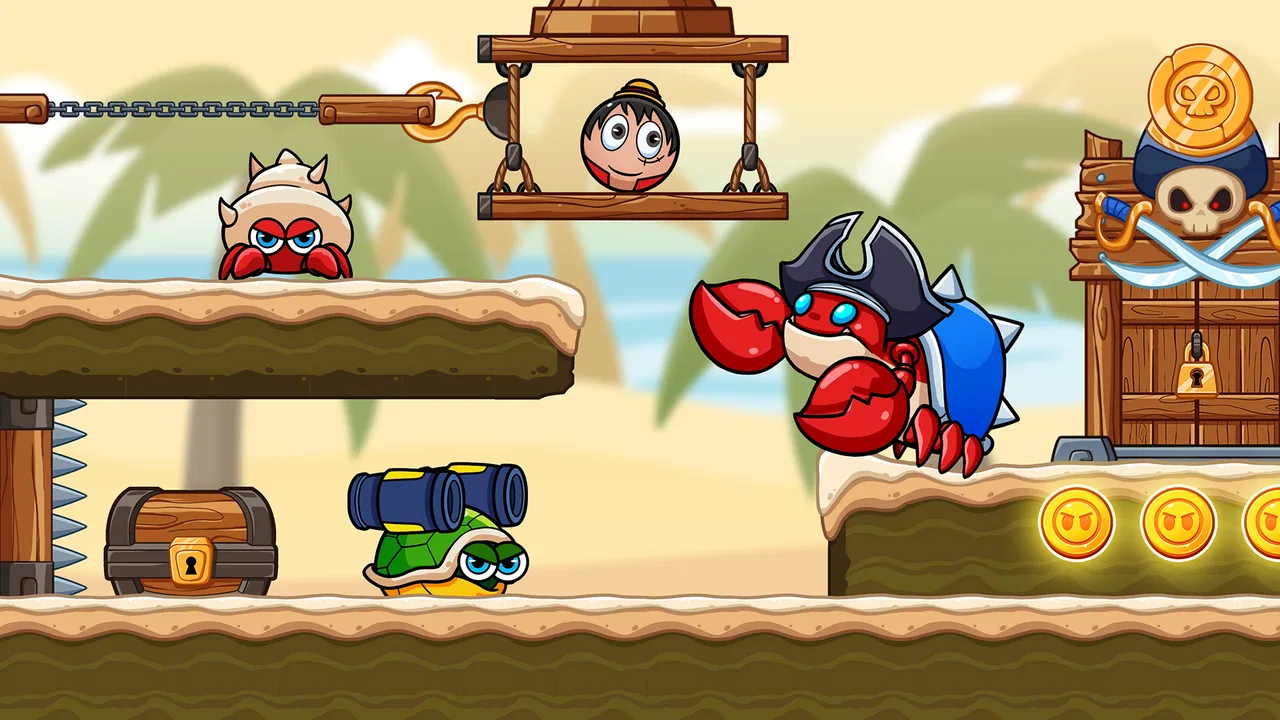
Ball V - Red Boss Challenge
- 4.4
- Rating
- 10.00M
- Installs
- Free
- Price

 Analysis by App-foxy
I went into Ball V - Red Boss Challenge expecting a simple rolling-ball game, and that is exactly where its appeal begins. The idea is easy to understand: guide a ball through an adventure built around danger, movement, and the goal of helping friends while working toward saving the world. What surprised me was how quickly a basic control concept can turn into a test of patience. A small mistake can matter, and the most enjoyable moments come from learning a route rather than simply rushing through it.
This is a free adventure game from MGIF, aimed at Everyone and available for devices running Android 7.0 or later. Its broad age rating makes it approachable for younger players, while the challenge gives adults a reason to keep playing for a few minutes at a time. The game has reached over ten million installs and holds a 4.4 average from around twenty-nine thousand ratings, so it clearly has an audience beyond a brief experiment. My own view is more specific: it works best when you want a compact reflex game with a light rescue-and-save-the-world theme, not when you are looking for a deep story or a large role-playing adventure.
What the rolling-ball format feels like in practice
The central pleasure is movement. Instead of controlling a character with a large set of abilities, I focus on keeping the ball moving safely, judging hazards, and reacting before the next mistake. That simplicity makes the opening easy to approach. I did not need a long tutorial or a complicated menu system to understand the basic objective. At the same time, simple controls do not automatically make a level easy. The challenge comes from timing, positioning, and recognizing when speed is helpful and when it creates trouble.
You May Also Like

 Blood Strike: 2.5 Anniversary
Blood Strike’s Loadouts Turn Every Drop Into a Tactical Gamble
A close look at Blood Strike’s custom loadouts: how fast access to signature weapons reshapes its battle royale rhythm, rewards preparation, and narrows the gap between fights.

 Pandora - Music & Podcasts
Pandora’s Music Is Easy to Start, but Harder to Recover
Pandora’s strength is its low-effort path from a seed to a station. Its weak spot is how much confidence it asks you to place in connection, setup, and quiet recovery.

 8 Ball Pool
 Is Built on Rivalries, Rematches, and Routine
A close look at the rivalries, rematches, shared routines, and unanswered safety questions that turn a quick pool match into a persistent mobile community.

 Samsung Music
’s Quiet Strength Is Playing What You Already Own
Its reach comes less from spectacle than from dependable access to a personal library. That simplicity is both the app’s strongest retention engine and its ceiling.

 AccuWeather: Weather Radar
AccuWeather Review: A Quick, Clear Forecast for Everyday Decisions
For everyday plans, the best forecast is the one you can understand quickly. AccuWeather makes rain timing, radar, and local conditions easy to act on, with a few trade-offs.

 Hill Climb Racing
Why Hill Climb Racing Still Turns Crashes Into One More Run
A tiny car, a bumpy hill and one more upgrade: Hill Climb Racing keeps resurfacing because its simple chaos makes every near-miss feel personal.
More From Our News Desk
View All News


The world-saving setup gives the runs a little more purpose than an endless score chase. Rescuing friends provides a reason to continue, while the Red Boss Challenge framing adds a clear sense of opposition. I would not play this expecting a story with long conversations or detailed character development. The narrative is better understood as motivation between action sequences: it gives the rolling and rescuing a direction without getting in the way of the game.
One useful way to approach each stage is to separate the first attempt from the successful attempt. On the first pass, I pay attention to the shape of the route and the timing of its hazards instead of trying to be perfect. After that, I replay with a better idea of where to slow down, where to commit, and where a safer line is worth more than a faster one. That trial-and-adjustment rhythm is the real structure of the game, and it is more satisfying than treating every failure as wasted progress.
Why short sessions suit this game
The format fits ordinary moments well. If I have a few minutes before leaving home, I can make progress without committing to a long story chapter or a multiplayer match. A short break after work also suits it, although difficult sections can be a poor choice when I am already tired or impatient. The game asks for attention even when the concept looks casual, and that contrast is important. It is easy to start, but not always easy to play carelessly.
For a younger player, the Everyone rating makes the premise approachable, but I would still expect the difficulty to produce frustration in places. Parents looking for a calm, no-pressure experience should know that a rolling platform challenge is likely to involve repeated attempts. For older players, that same repetition may be the main attraction. I enjoyed it more when I treated each try as practice rather than judging the game by how quickly I could finish.
Progress feels better when I manage mistakes
A practical tip is to avoid making every attempt a speed run. Rushing encourages corrective movements that can be harder to control than a deliberate pause. When the route becomes demanding, I find it more useful to watch the ball's position relative to the next hazard than to focus on the destination. This small change in attention makes the game feel less random. It also reveals a trade-off: a cautious approach can take longer, but it gives me more control over the moments that usually cause a restart.
Another useful habit is to identify the exact point where a run failed. If I simply restart and repeat the same movement, I am not really learning. I ask whether I entered too quickly, reacted too late, or chose a line that left no room for correction. That makes the challenge feel fairer because improvement comes from a specific adjustment. I cannot promise that every difficult moment will feel perfectly balanced, but the game is at its best when the failure teaches me something visible.
Spending, pressure, and what a free game means here
The game is free to download, which makes trying it straightforward. It also includes in-app purchases priced from $0.99 to $2.99 per item. That is the main financial detail I would want a new player to understand before starting. The presence of purchases means the free entry point should not automatically be read as a completely purchase-free experience. I would begin without spending anything and decide only after seeing whether the core challenge is enjoyable on its own.
I am careful about making stronger claims than the available purchase information supports. I cannot fairly describe the items as required, cosmetic, energy-based, or connected to a particular advantage without evidence. What I can say is that the price range is low enough for an impulse purchase, which is precisely why a little discipline helps. If a difficult section creates pressure to buy something, I would close the purchase screen, replay the route, and decide later. A frustrating moment is not a good reason to spend.
For families, the practical question is not only whether the game is suitable for Everyone. It is also whether the device owner has a purchase setup that a child can use without supervision. I would keep purchases protected and explain that free access and optional paid items are separate choices. That advice is not a criticism of MGIF; it is simply the sensible way to handle any free game with paid items.
Does spending change the challenge?
This is where I would keep expectations measured. The game clearly combines free access with individual purchases, but I would not label it pay-to-win or claim that purchases are irrelevant without knowing exactly what each item does. For a single-player rolling adventure, the more useful test is whether I can enjoy the ordinary progression without feeling pushed toward the store. I would play several sessions before making that judgment, especially because early difficulty and later pressure can feel very different.
My personal rule is simple: if I am buying because I genuinely want to support a game I already enjoy, the small item range is easier to justify. If I am buying because I am annoyed by a failed attempt, I wait. This keeps the challenge meaningful and prevents a cheap purchase from becoming a shortcut that removes the reason I started playing. The game works best for me when improvement remains the main reward.
Fairness, competition, and the right comparison
The word “challenge” can make people wonder whether this is a competitive game. I would not approach it as a direct contest with other players. Its appeal is personal improvement: learning the route, handling pressure, and getting farther through better control. That makes fairness less about leaderboards and more about whether the game gives me a reasonable chance to understand my mistakes.
Compared with a traditional platform game, the rolling-ball format removes much of the freedom that comes from jumping, attacking, or exploring on foot. That limitation is also its identity. I spend less time choosing abilities and more time managing momentum and position. Compared with an endless runner, it feels more deliberate because I am not only reacting to a constantly advancing screen; I am trying to solve the movement problem in front of me. Compared with a large adventure game, it is much lighter on story and discovery but far easier to pick up for a short session.
That comparison helps explain who should skip it. If you want open exploration, character customization, detailed quests, or a substantial narrative, this is probably too focused. If you dislike repeating a section after a mistake, the central challenge may become tiring. Players who prefer relaxed puzzle games may also find the reflex element more demanding than expected. On the other hand, if you like compact platform challenges and enjoy turning a failed run into a better one, the narrow design works in its favor.
How I judge fairness during a difficult run
I look for three things: whether I can see the danger, whether my correction feels responsive, and whether success comes from a repeatable decision rather than luck. When those elements line up, I accept a difficult section because I know what to practice. When they do not, frustration rises quickly. My advice is to give a troublesome section a few focused attempts, then take a break instead of playing angrily. A tired player often mistakes poor timing for poor design.
There is also a useful distinction between challenge and pressure. A hard route can be satisfying when it asks me to improve. Pressure appears when the surrounding presentation makes me feel that I should spend money or rush. Since the confirmed purchase information does not explain the role of each item, I would judge that part through actual play rather than assumptions. The fairest approach for a reader is to start free, observe how progress feels, and keep spending separate from the emotional moment of failure.
Device expectations and everyday use
The minimum operating system is Android 7.0, so the game is not restricted to only the newest Android phones. That makes it easier to consider for an older compatible device, although the experience can still depend on the phone's general performance and touch response. I would avoid judging the controls on a device with a damaged screen or noticeable input delay, because a precision rolling game depends heavily on consistent interaction.
In everyday use, I see two strong scenarios. The first is a short commute or waiting period where I want something more active than scrolling through social media but less demanding than a full console-style session. The second is a focused evening challenge where I replay one troublesome section until I understand it. The first scenario highlights convenience; the second highlights persistence. The game is less suitable when I need a quiet background activity, because the action requires concentration.
The current version is 1.7.8, and the game was released on November 25, 2022. Those details place it as an established title rather than a brand-new launch, which is consistent with its sizeable install base. I would still keep the app updated through the normal store process, especially if I notice control issues or compatibility problems. I would not assume that a version number alone guarantees a particular performance level on every phone.
Small habits that improve the experience
I prefer playing with notifications silenced. A sudden interruption at the wrong moment can turn a manageable movement into a failed attempt, and the game is more enjoyable when I can give it a few uninterrupted minutes. I also use a stable grip rather than holding the phone loosely, since small hand movements matter more in a ball-based platform challenge than they do in a menu-driven game.
When introducing it to someone else, I would not describe it merely as a “simple ball game.” That undersells the part that matters: the game asks the player to build a reliable movement habit. I would show the basic objective, then explain that repeated attempts are expected. This sets a better expectation for children and casual players than promising an easy experience because the controls look uncomplicated.
Who should play it and who should pass
I recommend it to players who enjoy focused arcade adventures, short retry cycles, and the satisfaction of mastering a route. It is also a reasonable choice for someone who wants a free game that can be sampled without learning a complicated combat system. The rescue theme gives the action a friendly goal, while the Red Boss framing adds enough urgency to keep the journey moving.
I would hesitate to recommend it to anyone specifically seeking a rich story. The world-saving premise is useful context, but the rolling challenge is the main event. I would also point away from it for players who want a purely relaxing game with no repeated failure. Even though the content rating is Everyone, suitability by age and suitability by temperament are not identical. A young player may understand the objective but still dislike the pressure of restarting.
For a competitive player, this is better approached as a personal skill test than as a serious esports-style experience. For a parent, it is worth combining the age rating with sensible purchase controls. For a casual adult, it is most rewarding when used in short, intentional sessions rather than as something to play mindlessly for a long time. Those distinctions matter more than the broad adventure label.
My trust verdict after playing
MGIF has built a game with a clear identity: roll carefully, face the challenge, rescue friends, and keep trying when the route punishes haste. The free price makes it easy to test, and the accessible age rating broadens its audience. The combination of a simple premise and demanding movement is its strongest quality, because it creates depth through control instead of cluttering the screen with systems.
My reservation is equally clear. The purchase range is known, but the practical effect of each item is not something I would assume in advance. I would therefore recommend starting free and treating every purchase as optional until the game has earned that decision through enjoyable play. I would also avoid promising that every difficult section will feel perfect for every player. Some people will see repetition as satisfying practice; others will see it as unnecessary friction.
Overall, I would recommend Ball V - Red Boss Challenge to a friend who likes rolling platform challenges and wants a free adventure game for short, hands-on sessions. I would describe it honestly as approachable at the surface but capable of testing patience underneath. If you enjoy learning from mistakes, the game has a good chance of holding your attention. If you want story-heavy exploration or a completely pressure-free pastime, another kind of adventure will suit you better.
The best way to decide is to install it, play without spending, and notice how you respond to the first genuinely difficult sections. If improvement feels rewarding, keep going. If the retries feel like work, no purchase will fix that basic mismatch. For me, the game earns a cautious recommendation because its core challenge stands on its own, provided I keep my expectations realistic and my spending deliberate.
FAQs for Ball V - Red Boss Challenge
01What is Ball V - Red Boss Challenge?
Ball V - Red Boss Challenge is a fast-paced arcade platform game focused on guiding a bouncing red ball through obstacle-filled levels. Players must avoid traps, time jumps carefully, collect useful items, and reach the goal while facing increasingly difficult layouts. The game combines simple controls with reaction-based challenges designed for short, replayable sessions.
02How do you play Ball V - Red Boss Challenge?
The gameplay is built around controlling the ball’s movement and timing its jumps through platforms, gaps, hazards, and moving obstacles. Although the controls are easy to understand, successful progress requires patience and accurate timing. Each level encourages you to learn the layout, avoid unnecessary risks, and repeat difficult sections until you can complete them consistently.
03Is Ball V - Red Boss Challenge suitable for beginners?
Yes, beginners can start playing because the basic mechanics are straightforward and do not require complicated button combinations. However, the difficulty can increase quickly, especially during sections involving narrow platforms, fast-moving traps, or boss-style challenges. New players should expect to replay levels several times while learning the timing and patterns needed to advance.
04Does Ball V - Red Boss Challenge require an internet connection?
The core platforming experience is generally designed to be playable without a constant internet connection, which makes it convenient for short sessions while traveling or when mobile data is unavailable. Nevertheless, features such as advertisements, updates, analytics, or other online services may require connectivity depending on the version installed and the device’s settings.
05Is Ball V - Red Boss Challenge free to download and play?
Ball V - Red Boss Challenge can typically be downloaded at no initial cost, allowing players to try the main gameplay before deciding whether to continue. Free versions may include advertisements, optional purchases, or other limitations. Before installing, it is worth checking the official store listing for the current pricing, permissions, supported devices, and in-app purchase information.
Pros
- Simple controls make the game easy to pick up quickly.
- Short levels are convenient for quick gaming sessions.
- Increasing difficulty keeps later challenges engaging.
- Minimalist visuals run smoothly on many devices.
- Restarting after failure is fast and keeps the pace moving.
Cons
- Some levels may feel repetitive after extended play.
- Precision-based obstacles can be frustrating on smaller screens.
- Progress may depend heavily on trial and error.
- Limited visual variety can reduce long-term appeal.
- Ads may interrupt gameplay
- depending on the app version.

Ball V - Red Boss Challenge
Gallery